


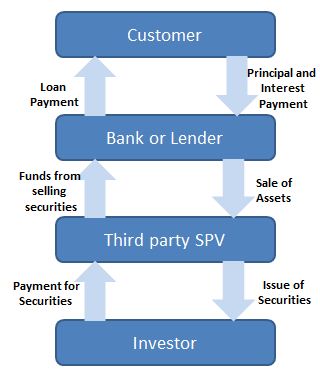
In 1938, FDR created Fannie Mae which served as a means by which the US government could facilitate the purchase of mortgages. Freddie Mac would later be created to obstruct Fannie Mae’s attaining of a monopoly over the mortgage market. Though, in order to understand Fannie and Freddie’s roles in the financial crisis, we must first understand the mortgage market as a whole, which consists of borrowers who purchase homes and lenders, which are the banks. Evidently, the bank lends funds to the borrower to facilitate these purchases and the borrower signs mortgages which ensure that they will pay back the loan with interest. The investment banks then buy these mortgages from the lenders and amalgamate hundreds if not thousands of them into a single investment product known as a mortgage backed security. These securities are then divided into tranches based on the level of risk of the loans, with junior tranches being riskier than senior tranches, and sold to investors. This is what is known as the securitization food chain. It becomes clear, upon removing the middlemen which are the banks, that the transaction takes place between the investors who purchase these securities and the borrowers. Ergo, the interest rate could be thought of as a price like any other; in essence coordinating the demand and supply of money. Hence the equilibrium rate is characterized by the rate at which lenders are willing to lend the specific sum of money that borrowers are willing to borrow. In 2008, the actions of Fannie Mae and Freddie Mac undermined this process due to the fact that they facilitated the provision of loans to extremely risky borrowers as they were not as acutely profit-driven as private institutions as they were implicitly aware of the fact that the incursion of a loss would be supplemented with government provision of financial assistance. This, in turn, procures the entrance of a great deal of borrowers to the market, risky borrowers in particular, which, evidently, results in an increase in the demand for housing and this, in turn, forms a housing bubble. As the economy stagnates and incomes fall, borrowers start defaulting on their mortgages, rendering these securities worthless and demand for housing collapses, while the supply of housing increases as banks confiscate and sell the homes of the defaulted borrowers, resulting in an extreme languishing in real estate value. Indeed, FM and FM controlled 40% of the mortgage market at the time and their subprime positions totaled $168 billion. Canada did not have a Fannie Mae and Freddie Mac equivalent at the time although Canadian banks did indeed buy these toxic mortgage backed securities which resulted in billions in losses to their balance sheet
 1986-Today